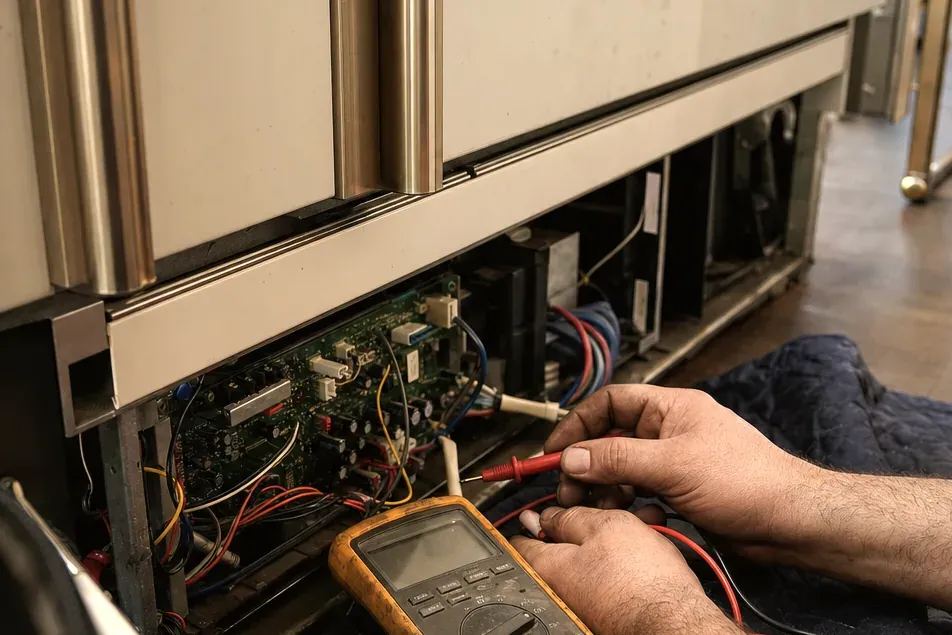
Where the machinery sits
Sub-Zero’s own comparison of its two built-in lines puts the grille, and the machine compartment behind it, at the bottom of Designer units and at the top of Classic ones, where it flips up. Either way most of the work happens from the front of the unit. That matters when the cabinetry has been scribed tight to the opening.
What we repair behind the panels
- Cooling. A fresh-food or freezer side creeping warm, frost on the back wall, a compressor that never seems to rest.
- Ice and water. No ice, slow fills, a drip at the valve or the supply line.
- Fans and condenser. A new noise from the grille, a fan that has stopped, a condenser choked at floor level.
- Controls. A blank or flashing display, alarms, a unit that keeps switching itself off and on.
- Door hardware. Hinges, closing cams, gaskets and panel alignment.
The door parts have pages of their own: the gasket and hinges and closers.
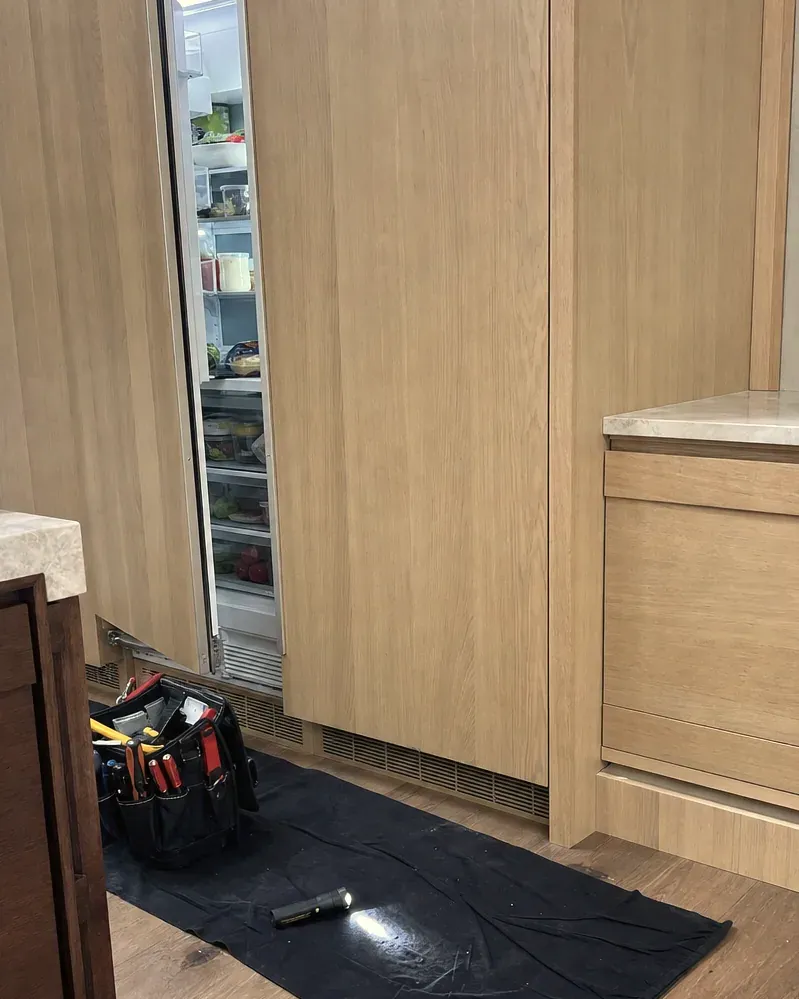
Panels come down and go back the same way
Before a panel is lifted off, we photograph where it sits and note the reveals on each side. It rests face up on padding while we work, its screws in a labeled bag. Afterwards it goes back on the same marks, and we compare the gap with the cabinet beside it at the top and the bottom. A panel that will not come away without risk to the finish, because it was glued or fixed in a way the installation guide does not show, gets a conversation first, not a pry bar.
Air in, heat out
A built-in breathes through its grille. A decorative kick plate fitted during a remodel, or a rug pushed up against the bottom of a Designer column, can starve the condenser. With nowhere to send its heat the compressor runs long, and the fresh-food side drifts warm. Part of every visit is checking that the air path the installation guide asks for is still open.
What it costs
The visit is $89, which pays for the diagnosis and comes off the repair bill if you go ahead. You approve the repair price before anything behind the panel is taken apart. As ranges, not quotes: an electronic control board typically runs $430–$940, a fan motor $340–$750, and compressor or sealed-system work $1,340–$3,330.
Before the visit
Does my cabinetmaker need to be there?
Not usually. Panels on Sub-Zero integrated units hang on brackets meant to come off for service. If yours was built in an unusual way, such as trim screwed across the joint or a panel tied into the cabinets beside it, mention it when you book and keep the cabinetmaker’s number to hand.
Will the unit have to come out of the opening?
Seldom. The grille, condenser, fans and most of the wiring are reached from the front. Sliding a built-in out of a tightly scribed opening means removing trim and putting the cabinetry at risk, so we treat it as a last resort and tell you before it happens, with the reason.