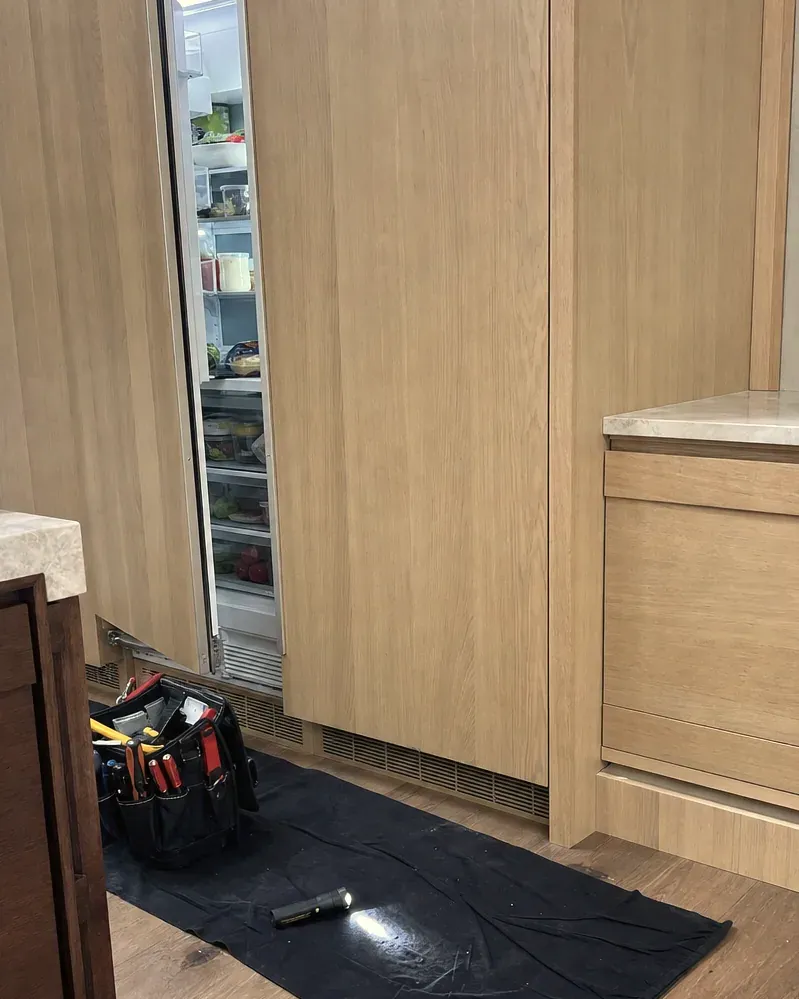
The simplest place to buy a new Sub-Zero fridge is a Sub-Zero dealer or showroom, which the dealer locator on the maker’s website will find for you; the dealer handles ordering, sizing and delivery scheduling, and the unit arrives with its full manufacturer warranty. A used one is a different kind of purchase. It may come out of a remodel, an estate sale or a reseller’s floor, or it may simply be part of the house you are about to close on. Either way the homework is the same: read the serial tag, confirm the model suits your opening, and test the seals, hinges and temperatures before you agree on a number. If you are touring listings in Cherry Creek North, Cherry Creek East or Country Club, the built-in in the photos is part of what you are paying for, and it deserves as much attention as the roof or the furnace.
New from a dealer, used, or conveyed with the house
Buying new gets you a current model, paperwork that starts on your delivery date, and one person accountable for getting the width, height and hinge side right. That last part matters more than people expect, because these units are fitted to the cabinetry rather than slid into a gap.
Buying used is mostly about price. A pulled built-in has to match your opening closely, it is heavy and tall, and moving it without damaging the floor or the cabinet face is a job of its own. Ask the seller plainly why it came out. A remodel that swapped finishes is a far better story than a unit that kept running warm.
When the fridge conveys with a home, you inherit whatever care the last owner gave it or skipped. Ask the sellers for the model and serial number, any repair invoices, and when the condenser was last cleaned. A general home inspector may open the door and note that it feels cold, but that is not a refrigeration check, and it will not tell you how close a fan or a control is to failing.
Classic or Designer: match the line to the kitchen
Sub-Zero renamed its refrigeration lines in March 2019. The Built-In series became Classic, the Integrated series became Designer, and PRO kept its name. Older listings still use the earlier names, so read them as the same families.
Sub-Zero steers buyers toward Classic when the refrigerator will stand on its own or have its sides partly exposed, and toward Designer when the aim is a front that disappears behind panels with very little metal showing. The grille tells them apart at a glance. Classic models have a flip-up grille along the top and come in 30, 36, 42 and 48 inch widths; Designer units carry the grille at the bottom and come in 24, 30 and 36 inch widths. A bargain 42-inch Classic will never fit an opening framed for a 36-inch Designer column, however good the price.
The model number fills in the rest. Sub-Zero’s key reads DET3050CIID/R as a 30-inch Designer combination refrigerator-freezer with an ice maker, an internal dispenser and a right-hand hinge, and CL3650RA/S/P/L as a 36-inch Classic all-refrigerator with a high-altitude glass door, stainless finish, pro handle and left hinge. That high-altitude glass option is worth noticing at Denver’s mile-high elevation: if you are shopping for a glass-door unit from a seller out of state, confirm which version of the door it has before it ships.
Read the serial tag before you talk price
The serial tag is the most useful thing on the unit, because it carries the manufacture date. Where you find it depends on the design. On Classic over-and-under models, including older 600 Series and 500 Series over-and-unders, look inside the refrigerator door near the top hinge. Side-by-sides keep it inside the freezer door, and Classic French-door models inside the left-hand door. On a Designer Column it sits inside the middle drawer beside the drawer guide, on the side away from the hinge. For Designer Tall and Designer Drawer models, check the cabinet wall just left of the top drawer, and on DEU undercounter units look up at the cabinet ceiling.
With a date in hand, place the unit on the timeline. The 500 Series was built from 1987 to 2003 and the 600 Series from 1996 to 2009, so either one is now at least seventeen years old. Legacy Classic BI models ran from 2008 to 2022, and Designer Tall and Column IT and IC models from 2014 to 2022; the current CL, DET and DEC lines took over in 2022. Age alone does not rule a unit out, but a seventeen-year-old refrigerator priced like a recent one gives you room to negotiate, and you should set money aside for the parts that wear with time.
Ten minutes of checks before you commit
- Door seals. Close each door on a strip of paper and pull it out at several points; it should drag evenly all the way around. Look for tears, flattened stretches and gaps at the corners. Our page on the door gasket explains why a poor seal is often a door problem in disguise.
- Doors and closers. Open each door partway and let go. It should swing shut and seal by itself. Panel-ready doors carry the weight of a custom wood front, so tired hinges show up as a door that sags, drags or leaves a gap at the top; see hinges, door closers and panel weight.
- Temperatures. Leave an appliance thermometer in each section for a few hours if the seller allows it. Both readings should land close to what the display says they are set to.
- Sound and airflow. The compressor and fans should run without grinding, clicking or rattling. Lift or look behind the grille: a thick mat of dust on the condenser means it has been working hard.
- Ice and water. Check that ice is being made and look for water stains under the unit. Do not panic if there is no filter to find: Sub-Zero says its 500 Series and 600 Series units, its wine storage other than the IW-30CI, its UC-24 and DEU undercounter refrigeration and its ID drawers have no internal water filter.
What the opening has to supply
Classic CL refrigerators need a 115-volt, 60-hertz supply on a dedicated 15-amp circuit with a three-prong grounded outlet, and Sub-Zero advises against a ground-fault outlet because a nuisance trip can shut the refrigerator off. The water connection is a quarter-inch outside-diameter line of copper, braided stainless steel or cross-linked polyethylene, fed at 35 to 120 psi through a shut-off valve you can reach easily. Self-piercing saddle valves are not allowed. In an older house, have an electrician confirm the circuit before delivery day rather than after.
Price the risk before you settle on a number
For a used unit or a home under contract, a diagnosis turns a vague worry into a figure you can bargain with. Our $89 visit brings a technician to the unit for a complete diagnosis, and the full $89 comes off the bill if you go ahead with the repair. These are typical ranges, with the firm quote given once the fault is found:
- A new door seal: $300–$700
- A worn fan motor, at the evaporator or the condenser: $340–$750
- A failed electronic control board: $430–$940
- A faulty defrost part, whether heater, thermostat or sensor: $260–$620
- Ice maker, inlet valve or supply line work: $280–$800
- Compressor or other sealed-system work: $1,340–$3,330
Set those beside $11,590–$23,100 for a comparable built-in replacement and it is clear why a well-kept unit with a known history is worth buying. If the refrigerator you end up with is a panel-faced model, our page on integrated and panel-ready Sub-Zero repair covers how we take panels down and refit them to their marks. To book a pre-purchase check, call (720) 790-7997 or use the booking button on this page.
Questions
Where can I buy a Sub-Zero refrigerator?
New Sub-Zero refrigerators are sold through independent appliance dealers and showrooms, and the dealer locator on Sub-Zero's own website lists the ones near you. Used units come out of remodels, estate sales and resellers, and plenty simply stay with a house when it sells. Whichever way you go, read the serial tag and run the condition checks in this guide before any money changes hands.
When is the best time to buy a Sub-Zero refrigerator?
The best moment is usually when a dealer has display units or leftover stock of a line that has just been replaced, so ask directly about floor models and closeouts. Premium built-ins are rarely marked down deeply, which makes those units the realistic opening. Buying early also leaves time to confirm the cabinet opening, hinge side and wiring before delivery.
Is a used Sub-Zero fridge worth buying?
A used Sub-Zero can be a sound buy when the serial tag shows a reasonable age, both sections hold the temperature they are set to, and the seals and hinges are in good shape. Compare the asking price with typical repairs: a gasket runs $300–$700 and sealed-system work $1,340–$3,330, against $11,590–$23,100 for a comparable built-in replacement. A firm figure always follows diagnosis.
Why would a Sub-Zero fridge stop cooling while the freezer still works?
Classic and PRO units use Dual Refrigeration, which means the fresh-food and freezer sections run on separate systems, so one side can quit while the other stays cold. A failed fan motor, a defrost fault or a sealed-system problem on the refrigerator side are the usual causes. Our visit costs $89, and that amount is credited toward the repair you approve.
Where is the serial tag on a Sub-Zero refrigerator?
On Classic over-and-under models the serial tag sits inside the refrigerator door near the top hinge, side-by-sides carry it inside the freezer door, and Classic French-door models put it inside the left-hand door. A Designer Column hides it inside the middle drawer by the drawer guide. The tag also prints the date the unit was built.