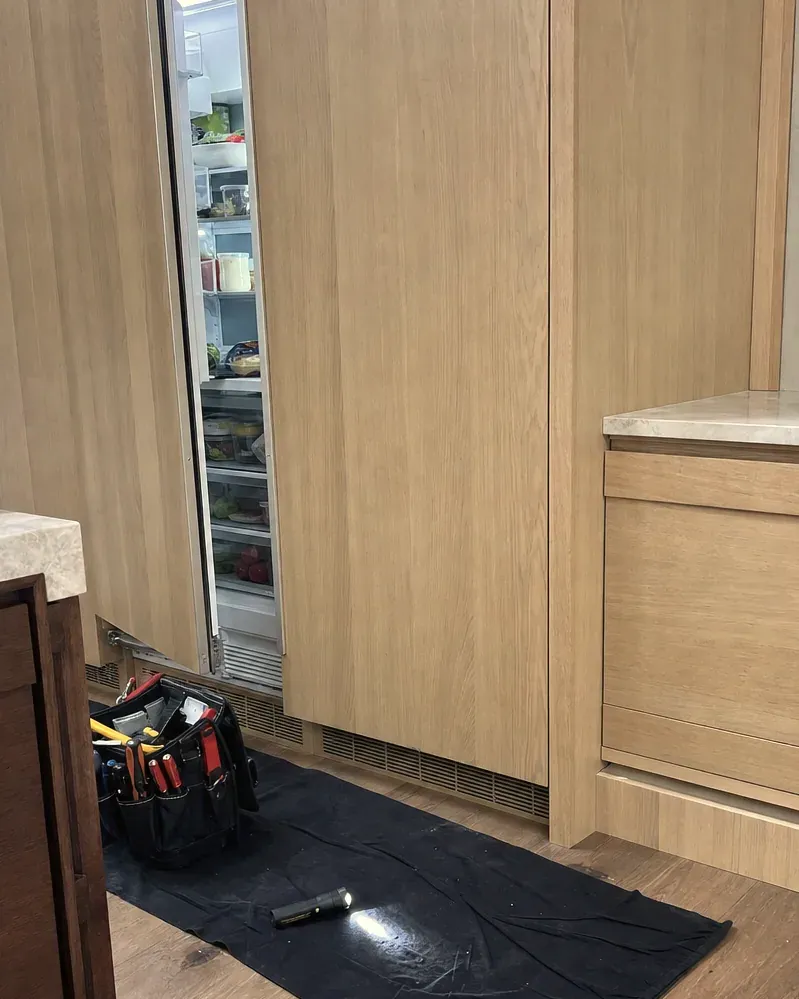
Most ice makers built into a refrigerator or freezer give five to ten years of dependable service, and small countertop machines usually wear out sooner, often within three to five. A built-in Sub-Zero ice maker that is cleaned on schedule and fed filtered water tends to sit toward the long end of that range; one that runs on unfiltered water with a dusty condenser can quit well before it. The refrigerator around it is a different story, because the cabinet and sealed system are built to keep going long after the first ice maker gives out. In Cherry Creek North, Cherry Creek East and Country Club, where the ice maker often hides behind a custom wood panel, knowing which of the two is actually aging saves a lot of guesswork.
How long each kind of ice maker tends to run
Ice makers come in three broad shapes, and they age differently. The module inside a refrigerator or freezer compartment is a small assembly: a mold, a heater that frees the cubes, a motor that turns the ejector, and a water valve outside the cabinet that fills it. Five to ten years is the usual working life for that assembly. A dedicated undercounter unit such as the Sub-Zero UC-15I or DEU1550I is a whole appliance with its own compressor and condenser, so its lifespan rides on how well that condenser and its water path are looked after. Countertop ice makers are built light, moved and refilled by hand, and are generally treated as replaceable after a few years. Water quality and upkeep shift every one of these figures.
Why the refrigerator usually outlives its ice maker
People who ask how long fridge freezers last with an ice maker are really asking two separate questions. The cabinet, compressor and sealed tubing of a built-in refrigerator are designed for a long life, and an attached ice maker does not make them work harder. The ice maker is the opposite: it cycles water, heat and a small motor many times a week, and every fill passes through a solenoid valve and a thin supply line that can scale up or crack. That is why the ice maker is usually the first part of a healthy refrigerator to need attention. A new module does not mean the refrigerator is nearing its end.
What wears an ice maker out early
Mineral scale is the main culprit. It coats the mold and the valve screen, so fills slow down, cubes come out small or hollow, and the heater and motor run longer every cycle. A water filter left in place long past its life adds to that by choking the flow. Low household water pressure does something similar, because the valve opens for its set time but lets in too little water. Heat matters as well: a condenser blanketed in dust makes the whole system run hot and long. Finally, a door that does not seal lets damp room air in, frost builds up around the ice maker, and its parts strain against it. Our door gasket page explains why a sagging hinge is so often behind that gap.
Water and cleaning intervals in Cherry Creek
Cherry Creek homes draw city water fed largely by mountain snowmelt, but its mineral content drifts with the season, so tune your cleaning interval rather than fixing a date. For the Designer undercounter ice maker, Sub-Zero wants a first clean at startup, then repeats every three to six months, sooner where the water is harder. The reminder ships set for three months, and one clean takes 1/2 cup descaler plus 1/2 tablespoon sanitizer. A UC-15I is cleaned and sanitized every six months: start the cycle with CLEAN, take every cube out of the bin, and once the light blinks add 4 ounces (115 ml) of cleaner; the sanitizing pass repeats that routine using 1 tablespoon (15 ml) of sanitizer. Each pass runs about 30 minutes and cannot be canceled midway.
Upkeep that adds years
Filters come next. A Classic (CL) or Designer (DET, DEC) refrigerator filter handles up to 750 gallons (2,839 L) of water, with twelve months as the outer limit; change it earlier if the indicator lights, pressure falls off or cubes turn hollow. The UC-15I takes filter 7042803, which superseded 7012333, and wants a fresh one every six months or after a long shutdown. After any filter change, discard the first two full bins on a non-dispenser CL, DET or DEC model, or the first batch on a UC-15I. Condensers need the same attention: Sub-Zero says every six to twelve months, sooner with pets in the house, brushing gently so the aluminum fins stay straight and skipping chemical cleaners altogether. On the UC-15I the condenser sits behind the kickplate and is due every six months.
Signs that age, not one part, is the problem
A single failed part tends to show up one way: no fill, a jammed ejector, a drip at one fitting. Age looks different. Several symptoms arrive together or follow each other within months, such as cubes shrinking even with a fresh filter, a motor that grinds or hesitates, cracked plastic around the mold, and brittle wiring near the heater. The clearest tell is a run of repairs where fixing one complaint only makes room for the next. When that pattern appears on a module past the middle of its expected life, replacing the whole ice maker assembly usually makes more sense than chasing parts one at a time. Our guide to installing a Sub-Zero ice maker covers what a careful swap involves.
Faults that look like old age but are not
Before writing off an ice maker, rule out the cheap explanations. On Classic (CL) and Designer (DET, DEC) units, pulling the bin starts a 3-minute delay, and Sub-Zero suggests switching the ice maker off if the bin will be out for a long spell, so a misplaced bin can pass for a dead module. Some Classic models show a single blinking cube symbol, with no chime, when the fill valve has run open longer than it should; the controls then disable ice production so the cabinet does not flood. Look over the water supply, then hold Alarm until CFC shows to clear the fault. A UC-15I glowing a red REPLACE FILTER light has reached 8000 ice-making cycles; fit a new filter and hold CLEAN for 6 seconds.
Repair or replace: putting the numbers side by side
Let the diagnosis drive the decision, not age alone. Fixing an ice maker, water valve or supply line costs a few hundred dollars, while a comparable built-in replacement refrigerator costs many times that, so a sound cabinet with a worn ice maker is usually worth keeping. The sums shift mainly when the sealed system is failing too. Have the serial number ready; UC-15I and DEU1550I owners will find the tag on the left wall inside the unit. A Creekside Panel Refrigeration visit is $89 and covers a technician at your panel-front unit plus a full diagnosis, and those $89 come off the invoice if you approve the work. Panel removal is explained on our integrated refrigerator repair page; the number is (720) 790-7997.
Questions
How long should a refrigerator ice maker last?
A refrigerator ice maker should give roughly five to ten years before the module itself needs replacing. Filtered water, a cleaning routine matched to how hard your water is and a dust-free condenser push it toward the longer end, while scale, an overdue filter and weak water pressure pull it toward the shorter one.
How long do fridge freezers last with an ice maker?
The refrigerator or freezer usually outlasts its ice maker by a wide margin. The ice maker is a small, busy assembly, while the cabinet and sealed system are built for a long working life, so a built-in unit can take a new ice maker module and still have many good years ahead of it.
How long do countertop ice makers last?
Countertop ice makers generally last only a few years, often somewhere around three to five, because they are lightly built and handled every day. Descaling them regularly and drying them out before storage helps. A built-in or undercounter unit plumbed to a water line is the sturdier, longer-lived choice.
How do I reset a Sub-Zero ice maker that stopped making ice?
Sub-Zero ice makers reset differently by model, so identify yours first. On some Classic units, a solitary blinking cube symbol without a chime is cleared by checking the water supply and then holding Alarm until CFC appears. On a UC-15I, the red REPLACE FILTER light resets when you hold CLEAN for 6 seconds after fitting a new filter.